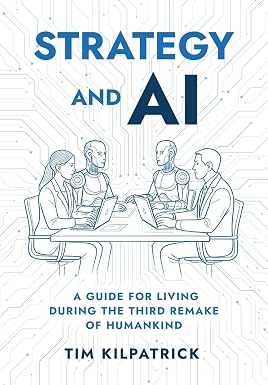
Sweeping in scope and grounded in real human stories.
What does a pair of enterprising grad students entering a prestigious research competition have to do with combating climate change or reducing systemic racism? According to Tim Kilpatrick, almost everything. In 2012, when Alex Krizhevsky and Ilya Sutskever entered the ImageNet contest, AI was a familiar concept, but neural networks had few practical uses, and no contestant had tried them before. The work of Alex, Ilya, and their adviser Geoffrey Hinton did more than win a contest; it proved that a machine taught to learn its own patterns could outperform years of hand-built expertise in a single stroke. What mattered wasn’t raw resources, but the nerve to trust an idea and the technical savvy to pull it off. This way of thinking laid the groundwork for years of AI progress and possibly the real blueprint for addressing humanity’s thorniest problems. In what author Tim Kilpatrick calls the “third remake of humankind,” we stand at the threshold of a long process of learning to wield a new, non-human form of intelligence against the challenges we’ve created. The widening gap between human problem-solving and human-made complexity may be the defining threat of our era, and artificial intelligence, used deliberately, could be our most promising tool for closing it.
Strategy and AI moves through four parts, opening with strategy cognition, the process by which the brain builds mental models of the world and devises plans to reach goals. Next, it turns to complexity, tracing why our institutions strain under challenges they were never designed to solve. The third part clarifies AI, walking through what it is, how it learns, and what it can realistically do. The final part shows individuals, organizations, institutions, and societies putting these tools to work. Story-led chapter openings draw readers in by modeling the reasoning behind ideas, so the methods can be easily absorbed. Kilpatrick highlights the innovative approaches of figures ranging from Thomas Edison to former professional poker player Annie Duke, illustrating what it means to think several moves ahead of the problem at hand. This isn’t just a book about cutting through the hype and doom that dominate the conversation around AI; it’s a game plan for confronting problems, one that treats complexity as something to be out-thought rather than merely endured. But ambition and rigor come at a small cost. The writing leans dense at times, familiar examples are retold more than they need to be, and the book’s own vocabulary can get in its way. Still, curious readers who want to understand where AI fits into the longer arc of human progress will appreciate the depth Kilpatrick brings to a conversation too often reduced to salvation or disaster. Sweeping in scope and grounded in real human stories, Strategy and AI is a bracing field guide for anyone determined to think clearly as the third remake unfolds.