A thoughtful work that lays the groundwork for a faith that is made stronger by finding its weakest points and repairing them.
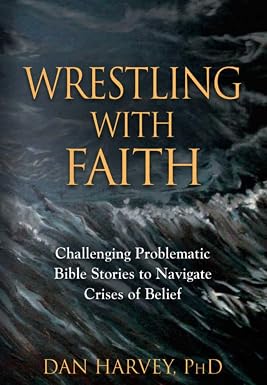
Imagine a home with a tiny leak in one corner of the roof. At first, it’s just a small discoloration on the ceiling, easy to hide, easier to ignore. The stain doesn’t spread and the roof looks fine from the outside, so you paint over it and move on, even though a leak with no visible exterior damage can still be doing harm underneath. Left alone long enough, that roof could collapse. Christian faith can be a lot like that leaking roof. If there are cracks in our theology, doubts we’ve never examined, or questions we’ve never been courageous enough to ask, isn’t it better to address them than to pretend they don’t exist? Faith with unexamined soft spots might not hold up when serious challenges come. In his book Wrestling with Faith, Dan J. Harvey encourages open discussion and honest evaluation. He notes, “A goal for this book is to challenge some long-standing interpretations and to face troubling Bible dogma head-on.” He quotes philosophers, historians, authors, scientists, and scripture itself, all in an effort to help Christians move past inherited assumptions, dismantle the unhealthy beliefs that keep them from growing, and learn to reason through difficult questions rather than default to rote answers.
Wrestling with Faith is an earnest, searching book that grew from real devastation. Harvey’s personal experiences include the sudden death of his seventeen-year-old son, the revelation of abuse his wife endured at a missionary boarding school, and years spent working with indigenous communities scarred by the colonial era. But rather than walk away from his faith, the author turned his training as a computer scientist toward the parts of Christianity he found hardest to defend. Working through subject matter as complex as whether belief in God is rational, whether the New Testament is historically reliable, whether scripture must be read as inerrant, and what to make of the violence, blood sacrifice, and divine anger of the Old Testament, the book moves methodically through demanding terrain. The author takes every opportunity to reason through the issues at hand by carefully weighing opposing views with an admirably open mind. His opinions and well-informed conclusions will resonate with readers who have struggled to rationalize a faith they love. At times, the arguments wander or circle so widely around the challenges that solid conclusions are difficult to locate, leaving some with thoughtful questions but little sense of resolution. But those who take a proactive view of problem-solving will appreciate Harvey’s patience, his willingness to take on the most persistent problems, and his genuine lack of pretension. Wide-ranging and candid, Wrestling with Faith is a thoughtful work that lays the groundwork for a faith that is made stronger by finding its weakest points and repairing them.