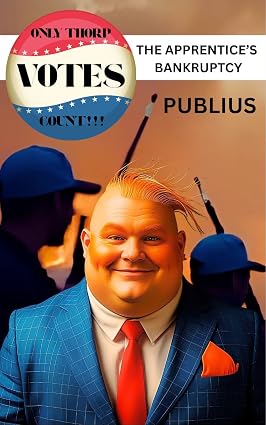
Absurd enough to laugh at and accurate enough to sting.
Daniel J. Thorp is confident he is winning at being president, but America has lost patience with the overgrown man-child. The Apprentice’s Bankruptcy opens with a delusional Thorp hunkered in the bunker beneath the East Wing’s new ballroom. His ruthless lawyer, Rawl Cline, informs him that his businesses are bankrupt, rioters are burning effigies near the White House, and the basement fortress is under siege. From there, the novel traces back to the roots of it all. Thorp’s father and his meager billion-or-so dollar fortune, Rawl’s slimy climb to notoriety, the disappointments that are Thorp’s wives and children, and every ill-gotten gain he never had to answer for that forged the cowardly president. Roody Googliano struts through as a fixer and Gerald Ramstein’s predatory rise gets its own dark spotlight. Familiar political and celebrity figures come and go, each feeding the inevitable fire of Thorpism that engulfs America. Sure, some disagreed before things got to this point. But when a petulant man is elected to the nation’s highest office, even illegitimately, it’s tempting to let the mess burn itself out. Thorp has a generous estimation of his own skill, influence, and popularity, but not even the President of the United States can cheat the ledger indefinitely. Today may belong to Thorp, but tomorrow doesn’t have to.
A blistering roman à clef that doesn’t bother to hide who it’s about, The Apprentice’s Bankruptcy is an autopsy of power, performed while the patient still insists he is in the best shape of his life, probably in better shape than anybody has ever been. The author calls the book an apologue rather than typical political satire, a funhouse-mirror history book whose distortions are built to deliver a moral lesson, not just a punchline. On that count, this book hits the mark. The bunker opening and the backward march through Thorp’s ruin lay the lesson bare. And when Thorp finally meets his match, his arrogance and ignorance play exactly the role they’ve been building toward throughout his entire life. Some of the satire lands on multiple levels, like the recurring banana republic imagery, genuinely ripe with meaning. The rest leans on the more predictable territory of cheap shots, childish jabs, and name-calling. Most of the book reads like a who’s who of barely-disguised political and pop-culture figures, each skewered in turn, each answering for their role in current affairs. Chapter titles are drawn from films and songs, and the allusions that follow, ranging from Dickens to twentieth-century cinema, work as jokes and arguments at the same time. The book’s overall tone is crude, and like-minded readers will appreciate the author’s outrage at our mirrored state of the union. A novel for those who believe the current administration is a parody of true democracy, The Apprentice’s Bankruptcy is absurd enough to laugh at and accurate enough to sting.